

Table of Contents
- Preparation and Cleaning Before Transport
- How to Prep a Refrigerator for Moving
- Essential Moving Heavy Appliances Equipment
- Safe Lifting Techniques and Ergonomics
- Securing Appliances in a Moving Truck
- Protecting Floors, Doorways, and the Appliance
- How to Transport Large Appliances: Post-Move Installation
- Frequently Asked Questions
Last Updated: September 21, 2026
Preparation and Cleaning Before Transport
Before you transport large appliances, unplug them at least 24 hours before moving day to allow residual electricity to dissipate and provide safe access to all components.
Empty the appliance completely, removing all food, ice, and removable shelves. For refrigerators and freezers, defrost if needed and clean the interior and exterior. Pay special attention to vents and coils, which can trap dirt that may cause problems during transport.

Document the appliance's current condition by taking photos from multiple angles for warranty claim purposes. Check the manufacturer's manual for any specific preparation steps required for your model.
How to Prep a Refrigerator for Moving
Refrigerators require special attention because they contain compressor oil and refrigerant that can shift during transport. Remove all shelves, drawers, and ice trays, and secure loose parts with bubble wrap or moving blankets.
Drain the water supply line completely if your refrigerator has an ice maker or water dispenser. Locate the shut-off valve behind the unit, turn it clockwise until water stops flowing, disconnect the water line, and empty any drain pan underneath.

Let the refrigerator sit upright for at least four hours after draining before moving it to allow compressor oil to settle. If previously transported horizontally or tilted, wait 24 hours before plugging in at the new location.
Secure the doors closed with moving straps or rope. Wrap the entire unit in moving blankets and use ratchet straps to hold the blankets in place. The U.S. Department of Energy guidance on appliance moving recommends keeping refrigerators upright during transport to prevent compressor damage.
Essential Moving Heavy Appliances Equipment
Moving large appliances safely requires equipment matched to your appliance's weight and dimensions; undersized or wrong equipment causes dropped appliances and injuries.
Dolly and Hand Truck Selection
An appliance dolly is purpose-built for tall, narrow units like refrigerators and freezers with a wider base and curved lip. A standard hand truck works for upright appliances but offers less stability on uneven floors. For washing machines and dryers, an appliance dolly reduces tipping risk significantly.
Your dolly's weight capacity must exceed your appliance's weight by at least 25%. Check the manufacturer's nameplate for exact weight. Overloading a dolly causes wheel failure, loss of control, and dropped appliances.
Lifting Straps and Forearm Forklifts
Lifting straps distribute weight across your forearms and shoulders instead of concentrating force in your hands, wrists, and lower back. Essential for appliances over 150 pounds, especially on stairs or tight doorways, they reduce back strain by 40-60% compared to grip-only lifting.
Choose straps with reinforced stitching and padded arm sections. Test the straps' weight capacity before use, they should handle at least the full weight of your appliance plus 20% margin.
Ratchet Straps and Tie-Down Systems
Ratchet straps secure appliances inside the moving truck and prevent shifting during transit. Use straps rated for at least 1,000 pounds of working load limit (WLL). Ensure the truck has integrated tie-down points (D-rings or e-track rails) built into the cargo area.
Use at least four straps for a single large appliance: one across the top, two on the sides, and one across the bottom if accessible. Tighten until the appliance cannot move, but not so tight that you deform the cabinet or damage internal components.
Additional Essential Equipment
- Moving blankets: Use 4-6 blankets per large appliance, each at least 80 inches long. Thicker blankets (1-2 inches) absorb impact better than thin ones.
- Furniture pads: Place under dolly wheels to protect hardwood and tile floors. Reusable felt pads work better than cardboard.
- Cardboard corner guards: Protect appliance corners from impact. Cut pieces 12-18 inches tall and secure with moving tape.
- Bubble wrap: Use for detachable parts and delicate surfaces like glass doors. Wrap in at least two layers.
- Moving tape and markers: Secure blankets and label which side is "up" on the appliance.
- Dolly with pneumatic wheels: Pneumatic (air-filled) wheels absorb shock better on uneven surfaces and stairs than solid rubber wheels.
Weight Distribution in the Moving Truck
Place the heaviest appliance (usually a refrigerator or freezer) toward the front of the truck bed, directly behind the cab. This placement keeps the truck's center of gravity forward, preventing the truck from tipping backward on slopes or during braking.

If moving multiple appliances, arrange them by weight: heaviest in front and center, lighter units toward the back and sides. Never stack appliances unless the manufacturer explicitly states they're stackable.
Maintain at least 12 inches of clearance between the appliance and the truck's side walls. This gap prevents the appliance from being crushed if the truck sways on curves and allows air circulation, which reduces condensation and mold risk during transport.
Safe Lifting Techniques and Ergonomics
Improper lifting causes back injuries that can affect you for years. Always bend at your knees, not your waist. Keep your back straight and let your leg muscles do the work.
When lifting with another person, communicate clearly using signals like "lift on three" so you both move simultaneously and maintain the same posture and pace.
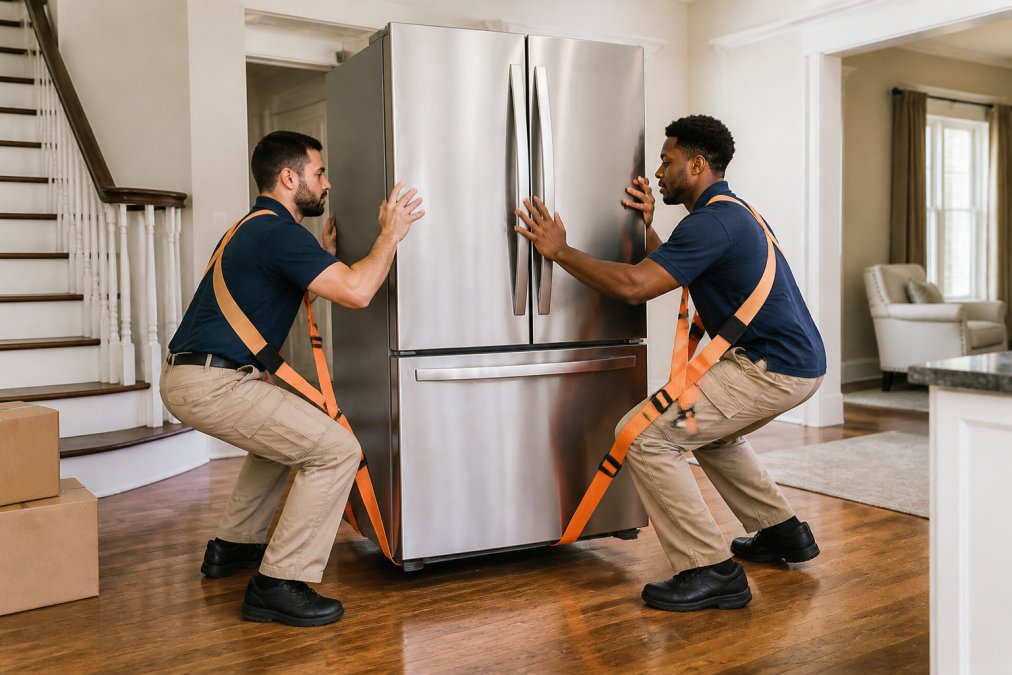
Never twist your torso while holding weight; move your feet instead to prevent spine strain. Keep the appliance close to your body rather than holding it away from you.
LG 29.5 Cu.Ft. Refrigerator/Freezer →
Use lifting straps to shift weight from your hands to your arms and shoulders, distributing the load evenly. This is far safer than gripping edges or corners, which can slip and cause drops.
Take breaks frequently; stop every 10-15 minutes to rest and rehydrate. If you feel pain, stop immediately.
Securing Appliances in a Moving Truck
Position the appliance toward the front of the truck bed, behind the cab, to keep weight balanced and prevent sliding backward during braking.
Use ratchet straps to anchor the appliance to the truck's tie-down points: one across the top and two on the sides. Tighten firmly but not so tight that it deforms the exterior.
For refrigerators and freezers, ensure the unit remains upright throughout transport. Tilting or laying these appliances on their sides can damage the compressor and allow refrigerant to escape.
Place heavier appliances toward the center and lower in the truck bed. Never stack appliances on top of each other unless they're specifically designed to be stacked.
Leave adequate space between the appliance and the truck walls. This gap allows for air circulation and prevents the unit from being crushed if the truck sways. If you're moving multiple appliances, maintain at least 12 inches between each unit.
Protecting Floors, Doorways, and the Appliance
Lay down cardboard or plastic sheeting in hallways and doorways to prevent scratches and dings to hardwood or tile floors. Furniture pads under the dolly add extra protection.
Measure your doorways and hallways before moving day and compare to your appliance's dimensions. Account for the dolly width. If clearances are tight, you may need to remove the dolly and carefully tilt the appliance through the doorway.
Most appliance damage occurs at doorways. Remove doors from hinges if necessary to create additional space. Protect the appliance's corners with cardboard guards and bubble wrap.
Wrap the entire appliance in at least two layers of moving blankets, securing them with moving tape. Pay special attention to corners, edges, and protruding components like handles or water lines.
For appliances with glass doors or delicate finishes, apply bubble wrap directly to the glass, then cover with blankets. Mark these areas clearly so handlers know to treat them gently.
How to Transport Large Appliances: Post-Move Installation
Improper installation after delivery can damage the appliance, void warranties, or create safety hazards.
Settling and Waiting Periods
Allow the appliance to sit in its new location for at least one hour before plugging it in. For refrigerators and freezers transported upright, wait at least four hours before powering on. If tilted or transported horizontally at any point, wait 24 hours. Powering on too soon can cause compressor failure, a repair costing $300-800.
Leveling the Appliance
Reconnecting Water and Drain Lines
Electrical Connections and Safety Checks
Temperature and Performance Verification
Documentation and Warranty Protection
When to Call a Professional Installer
Frequently Asked Questions
Is it okay to lay a refrigerator down when transporting it?
No, avoid laying a refrigerator on its side or back during transport. Compressor oil can flow into the cooling lines and damage the system. Keep refrigerators upright throughout the move. If the appliance must be tilted briefly during doorway passage, limit the angle to 45 degrees and keep it upright again as quickly as possible. This applies to most large refrigerators and freezers.
What equipment is necessary for moving heavy appliances?
Essential moving heavy appliances equipment includes an appliance dolly or hand truck rated for the weight, ratchet straps to secure the appliance, lifting straps to distribute weight across your forearms, furniture pads or blankets for floor protection, and a moving truck with sufficient load capacity. A forearm forklift can help with two-person lifts. Measure doorway clearance and hallway widths before moving to ensure the appliance fits.
Do I need to disconnect water lines before moving a washer?
Yes, disconnect all water supply hoses and drain hoses before moving a washing machine. Turn off the water valves, unscrew the hoses, and drain any remaining water into a bucket. Secure the hoses to the back of the machine with tape or straps to prevent kinking during transport. Check your washer's manual for specific disconnection instructions, as some models have transit bolts that must be installed to protect the drum during movement.
What appliances are hardest to move?
Refrigerators, freezers, and large washers are among the hardest appliances to move due to their weight, awkward dimensions, and the need for careful handling to prevent internal damage. Refrigerators require upright positioning throughout transport to protect the compressor. Washers need drain hoses disconnected and transit bolts installed. The weight distribution and pivot point of these appliances make them challenging to maneuver through doorways and up stairs without proper equipment and technique.